
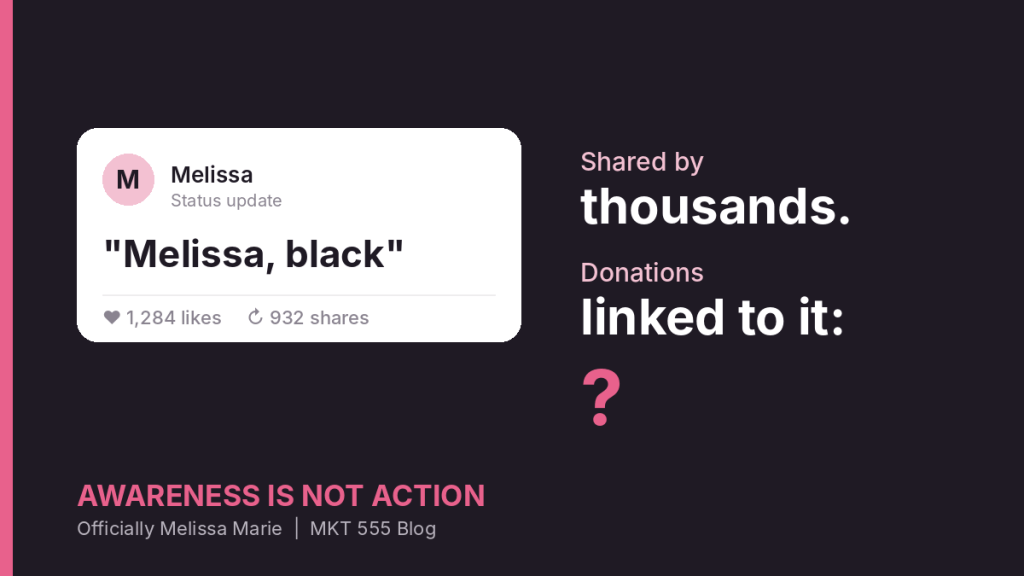
When a viral post feels good but changes nothing, what did it really accomplish?
Imagine opening your textbook and finding your own name in the case study. That happened to me this week. In Chapter 4 of Strategic Social Media, the sample status from the famous Facebook breast cancer meme reads, word for word, “Melissa, black” (Mahoney & Tang, 2017).
It is October, which is Breast Cancer Awareness Month, so the timing felt personal. It also raised a question every marketer should ask: did any of those posts actually help anyone?
The Case in Brief
In January 2010, women started getting a private message asking them to post the color of their bra as their Facebook status, with no explanation. The men in their lives were supposed to be confused, and the guessing game would “raise awareness.” NPR covered how fast it spread. Later versions got racier, like posting where you “like it” (your purse, supposedly). Susan G. Komen reported a bump in interest, but nobody could tie actual donations to the meme (Mahoney & Tang, 2017).
Why It Went Viral
Looking at it through this module’s reading on audience motivations, the meme checked every box:
- It was easy. One word, one click, no cost.
- It felt exclusive. A secret shared only among women made people feel like insiders.
- It was playful. Curiosity and a little cheekiness are powerful reasons to share.
- It made people look good. Posting told your whole network, “I care about a good cause.”
Uses and gratifications research tells us people choose media that meets their own needs (Mahoney & Tang, 2017). This meme delivered belonging, entertainment, and a positive self-image all at once. No wonder thousands of people passed it along.
Where It Fell Short
Spreading a message is not the same as moving people. The textbook calls this the difference between diffusion and mobilization. The bra meme was pure diffusion, basically a pink version of “push and pray” marketing. It had three big gaps:
- No action step. No donation link, no screening reminder, no self-exam guide. Just a color.
- It shut men out on purpose. Men get breast cancer too. The CDC notes that about 1 in every 100 breast cancers diagnosed in the U.S. is found in a man.
- It trivialized the disease. Many people, including survivors, felt that turning breast cancer into a flirty guessing game missed the point.
Awareness without action is just noise with a cause attached.
Melissa Marie
What Would Have Worked Better
Compare it to the ALS Ice Bucket Challenge. It had the same viral ingredients: fun, a little silly, and built for sharing. The difference? It came with a clear action: take the challenge or donate, and the money raised helped researchers identify a new gene linked to ALS. That is mobilization.
Using the textbook’s mobilization action plan, here is how I would rework the breast cancer meme:
- Keep the fun, add a step. Post your color, then tap to book a screening or give $5.
- Invite everyone. Ask men and women alike to share who they are doing it for.
- Turn posts into real user-generated content. Photos from a local walk, a survivor’s story, a thank you to a nurse.
- Hand over the story. Like TOMS did with #iamtom, let people own the narrative so they feel a strong sense of control and become advocates.
What This Means for Marketers
In my last post, I wrote about how Warby Parker earns trust by letting happy customers do the talking. This case shows the flip side. Participation alone is not the goal. Every October, brands paint their feeds pink, but most people already know breast cancer exists. The real gap is action: screenings, donations, and support for patients and families.
Before launching a cause campaign, ask the question the textbook asks: is lack of awareness really our biggest challenge? If not, build the campaign around the action, and let the virality carry it.
So this October, if a mysterious status request lands in your inbox, share it if you want. Then do one real thing. Book that screening, donate to a group like the National Breast Cancer Foundation, or check on a friend in treatment.
Which cause campaign actually got you to act, not just share? Tell me in the comments.
Case study source: Mahoney, L. M., & Tang, T. (2017). Strategic social media: From marketing to social change. Wiley Blackwell. Featured image: original graphic by Melissa Marie. AI disclosure: I used Claude (Anthropic) to help research and outline this post, then drafted, reviewed, and edited it myself.


Leave a Reply